Vestra

How it is made — The process

Four stages, none of them rushed.

Fibre, spinning, weaving, finishing — in that order. The order matters more than the speed: a yarn spun unevenly will not weave evenly, and no finish can rescue a cloth woven from weak yarn.

Hands grading raw cotton fibre

01

Fibre

It starts as raw fibre — graded by hand for length and fineness. A short, uneven fibre spins a weak yarn, so this slow step is never skipped.

Grading is slow on purpose. Sorting the fibre by length and fineness evens out what the spinning frame receives — an uneven feed spins an uneven yarn, and an uneven yarn breaks on the loom. The step looks like nothing is happening; it is the step that decides whether the rest of the work survives.

Tools
Hands · grading table
Material
Raw fibre

Step 01 / 04 — Next: Spinning

Yarn on bobbins at a spinning frame

02

Spinning

The fibre is drawn out and twisted into yarn on the spinning frame. The yarn is spun even and strong — a weak yarn breaks on the loom, and a broken warp stops the whole weave.

Drawing comes first: fibre that is not drawn even cannot be twisted even, and a yarn that is not even cannot weave even. Once drawn, the fibre is twisted a little at a time — strong enough to hold, fine enough to weave light.

Tools
Spinning frame · bobbins
Material
Sliver and roving

Step 02 / 04 — Next: Weaving

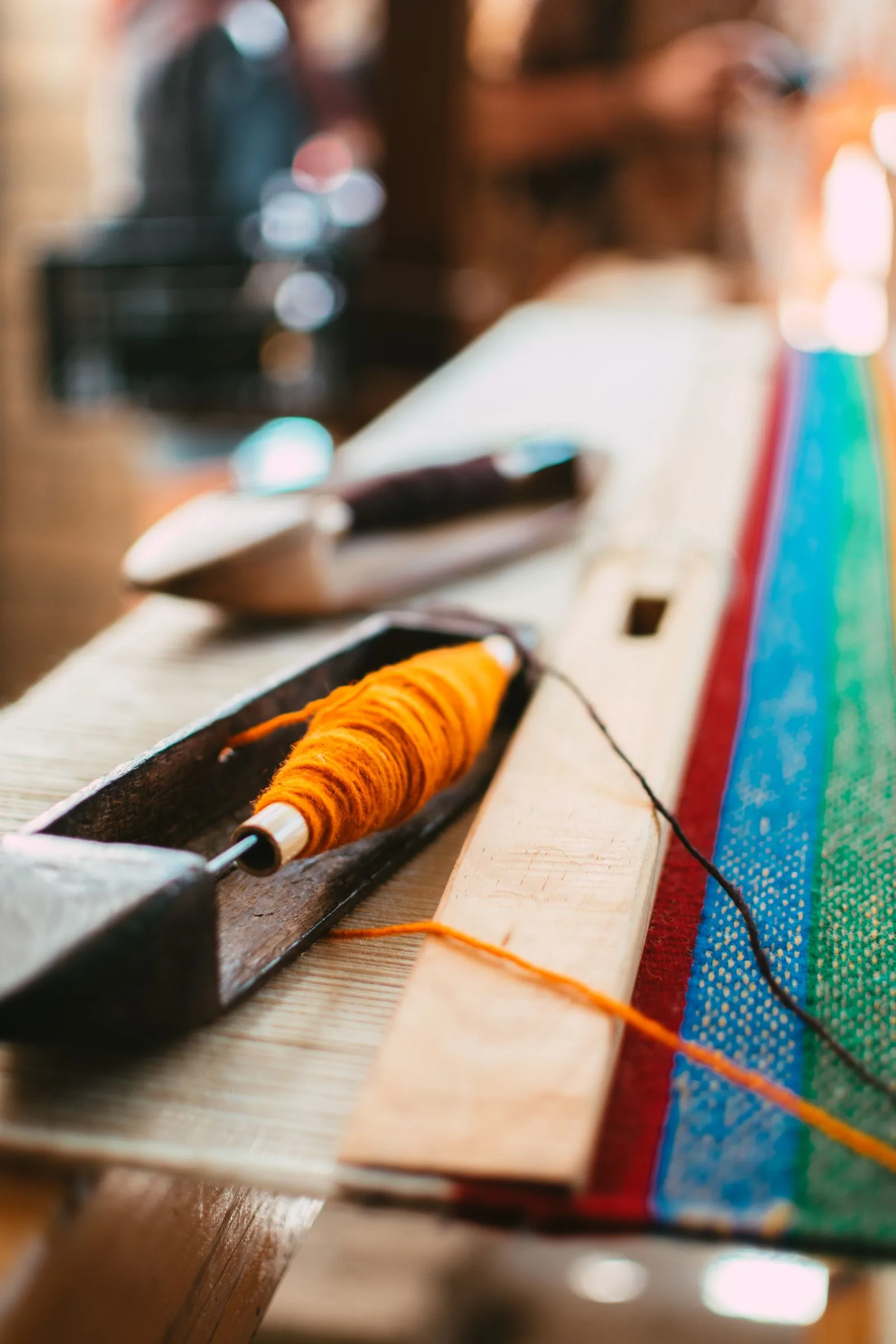
A shuttle moving across warp threads on a loom

03

Weaving

On the loom, warp and weft cross pick by pick. The weave is the cloth's character — plain, twill, satin or dobby — and it is set here, not afterwards.

Weaving has two moments. First the warp is dressed — every thread in its place, at the same tension, across the whole width. Then the weft crosses, pick by pick, and the cloth grows. Both happen slowly, at an even pace, so every part of the cloth comes off the loom the same.

Tools
Loom · shuttle · warp beam
Material
Spun yarn — warp and weft

Step 03 / 04 — Next: Finishing & QC

Finished cloth being inspected on a table in a mill

04

Finishing & QC

The cloth is washed, set to width and checked metre by metre. Finishing sets the hand; inspection catches what the loom missed — a missed pick, a thick place, a stain.

Washing gives an even hand; setting fixes the width. Either way the finish settles the cloth differently across its width, so no two cuts behave exactly alike. Inspection does the last of the work — a missed pick, a thick place, a stain are all caught here, before the cloth ships.

Tools
Washing range · stenter · inspection table
Material
Loom-state cloth · finish liquor

Step 04 / 04 — Then it ships

Slow is the method.

Nothing here is hurried to meet a deadline. Each stage waits for the one before it — that is the whole technique.

From the mill

The work, as it happens.

Six frames from the mill floor — the same photographs used across the catalogue, gathered in one strip.

A weaver at a loom in a bright textile mill
In the mill — weaving on the loom
A loom with woven cloth in a textile mill
A loom with cloth fresh off the beam
Hands grading raw cotton fibre
Grading — hands on the fibre
Yarn on bobbins at a spinning frame
Spinning — yarn on the frame
A shuttle moving across warp threads on a loom
Weaving — the shuttle moving
Finished cloth being inspected on a table in a mill
Finished — washed, set and checked

Photography: Pexels, free licence.

What the process makes

See the pieces this makes.

Every collection in the catalogue goes through the same four stages. The weave is the only thing that changes.

Explore the collections →